Introduction
Ever wondered why some industrial facilities operate with whisper-quiet precision while others sound like construction sites? The secret often lies in overlooked details—like the acoustic dampening properties of cable glands. Most engineers focus on IP ratings and temperature resistance, but noise control is becoming a critical performance metric.
Cable glands with superior acoustic dampening properties reduce vibration transmission and noise propagation through cable entry points, making them essential for noise-sensitive applications like recording studios, hospitals, and precision manufacturing facilities. This specialized characteristic transforms ordinary cable management into sophisticated noise control solutions.
Last year, I received an unusual call from Marcus, a facility manager at a high-end recording studio in Nashville. Their newly installed equipment was picking up mysterious vibrations through the cable entries, ruining million-dollar recording sessions. This challenge opened my eyes to the fascinating world of acoustic engineering in cable gland design—a niche that’s rapidly gaining importance across multiple industries.
Table of Contents
- What Are Acoustic Dampening Properties in Cable Glands?
- How Do Cable Glands Reduce Noise and Vibration?
- Which Industries Benefit Most from Acoustic Cable Glands?
- What Materials Provide the Best Acoustic Performance?
- How to Specify Acoustic Requirements for Cable Glands?
- FAQs About Acoustic Dampening Cable Glands
What Are Acoustic Dampening Properties in Cable Glands?
Think of your facility’s electrical infrastructure as a giant musical instrument—every component can either amplify or dampen sound transmission.
Acoustic dampening properties in cable glands refer to the material’s ability to absorb sound energy and reduce vibration transmission through cable entry points, measured in decibels (dB)1 of noise reduction and vibration isolation coefficients. These properties prevent sound waves from traveling through cable pathways into sensitive areas.

The Science Behind Sound Control
Sound transmission through cable glands occurs via three primary mechanisms:
- Airborne Transmission: Sound waves traveling through air gaps around cables
- Structure-Borne Transmission2: Vibrations conducted through solid materials
- Cable-Borne Transmission: Mechanical vibrations traveling along cable sheaths
Traditional cable glands focus primarily on sealing against environmental factors, but acoustic versions incorporate specialized materials and design features to interrupt these transmission paths.
Key Performance Metrics
When evaluating acoustic dampening properties, we consider several measurable parameters:
| Property | Standard Range | High-Performance Range |
|---|---|---|
| Sound Reduction | 15-25 dB | 30-45 dB |
| Vibration Isolation | 70-80% | 85-95% |
| Frequency Response | 500-2000 Hz | 100-8000 Hz |
| Damping Coefficient | 0.05-0.15 | 0.20-0.40 |
Material Selection Impact
The choice of sealing materials dramatically affects acoustic performance. Our engineering team has found that specialized elastomers with high internal friction coefficients provide superior dampening compared to standard rubber compounds.
How Do Cable Glands Reduce Noise and Vibration?
Understanding the mechanisms behind acoustic dampening helps engineers make informed selection decisions.
Cable glands reduce noise and vibration through multiple integrated approaches: vibration-absorbing materials, air gap elimination, mechanical decoupling, and resonance frequency shifting to move problematic frequencies outside sensitive ranges.
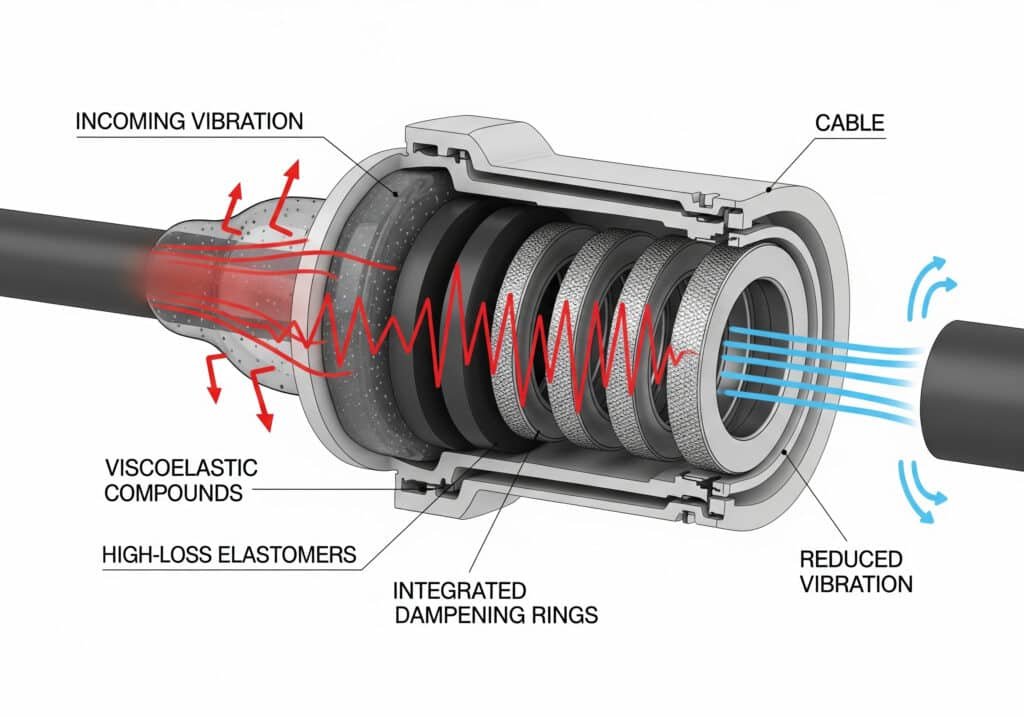
Vibration Absorption Techniques
Modern acoustic cable glands employ several sophisticated dampening strategies:
Material-Based Absorption:
- High-loss elastomers that convert mechanical energy to heat
- Viscoelastic compounds with optimal glass transition temperatures
- Composite materials combining rigid and flexible elements
Structural Design Features:
- Multiple sealing chambers creating acoustic barriers
- Graduated stiffness transitions reducing impedance mismatches
- Integrated dampening rings at critical coupling points
Real-World Performance Example
Hassan, who manages a pharmaceutical manufacturing facility in Frankfurt, contacted us about vibration issues affecting their precision weighing equipment. The problem traced back to HVAC system vibrations transmitting through cable glands into sensitive laboratory areas.
After installing our acoustic-dampening cable glands, they achieved:
- 38 dB noise reduction at cable entry points
- 92% vibration isolation efficiency
- Elimination of measurement errors caused by structural vibrations
Frequency Response Considerations
Different applications require acoustic performance across specific frequency ranges:
Low Frequency (20-200 Hz): Building vibrations, heavy machinery
Mid Frequency (200-2000 Hz): HVAC systems, motor noise
High Frequency (2000-20000 Hz): Electronic interference, precision equipment
Our acoustic cable glands are engineered with frequency-specific dampening characteristics to address these varied requirements.
Which Industries Benefit Most from Acoustic Cable Glands?
Certain industries have discovered that acoustic cable glands provide competitive advantages beyond basic noise control.
Industries with the highest acoustic requirements include recording studios, medical facilities, precision manufacturing, research laboratories, and high-end residential applications where noise control directly impacts performance or comfort.
Healthcare and Medical Facilities
Hospitals and medical centers require exceptionally quiet environments:
- Operating Rooms: Eliminating equipment noise that could distract surgeons
- Patient Recovery Areas: Reducing stress-inducing environmental noise
- Diagnostic Equipment: Preventing vibration interference with sensitive instruments
- Sleep Study Centers: Maintaining acoustically controlled environments
Precision Manufacturing
Manufacturing facilities producing high-precision components cannot tolerate vibration:
Semiconductor Fabrication:
- Clean room noise control requirements
- Vibration isolation for lithography equipment
- Prevention of acoustic contamination
Automotive Testing:
- Engine test cell acoustic isolation
- NVH (Noise, Vibration, Harshness)3 measurement facilities
- Quality control laboratory environments
Entertainment and Media
The entertainment industry drives many acoustic innovations:
- Recording Studios: Achieving professional-grade acoustic isolation
- Broadcast Facilities: Eliminating technical noise from live productions
- Concert Venues: Managing acoustic feedback and noise control
- Home Theaters: Creating immersive audio experiences
Research and Development
Scientific research often requires ultra-quiet environments:
University Laboratories:
- Acoustic research facilities
- Materials testing laboratories
- Precision measurement environments
Corporate R&D Centers:
- Product development testing
- Acoustic signature analysis
- Competitive benchmarking facilities
What Materials Provide the Best Acoustic Performance?
Material science drives acoustic performance, and recent advances have opened new possibilities for noise control.
The best acoustic dampening materials for cable glands include specialized viscoelastic polymers4, constrained layer dampening systems, and hybrid composite materials that combine high internal loss factors with excellent environmental resistance.
Advanced Polymer Systems
Modern acoustic cable glands utilize sophisticated material technologies:
Viscoelastic Elastomers:
- Temperature-stable dampening across wide ranges
- High loss tangent values for energy dissipation
- Chemical resistance for harsh environments
Constrained Layer Systems:
- Alternating rigid and flexible material layers
- Optimized thickness ratios for maximum dampening
- Integrated design preventing delamination
Performance Comparison Matrix
| Material Type | Dampening Factor | Temperature Range | Environmental Resistance |
|---|---|---|---|
| Standard EPDM | 0.08-0.12 | -40°C to +120°C | Good |
| Acoustic TPE | 0.18-0.25 | -30°C to +150°C | Excellent |
| Viscoelastic Compound | 0.25-0.40 | -20°C to +180°C | Superior |
| Hybrid Composite | 0.30-0.45 | -40°C to +200°C | Outstanding |
Manufacturing Considerations
At Bepto, our injection molding capabilities allow us to precisely control material properties:
- Multi-shot Molding: Creating integrated dampening layers
- Material Compounding: Custom formulations for specific applications
- Quality Control: Acoustic testing of every production batch
Environmental Durability
Acoustic materials must maintain performance across environmental extremes:
Chemical Resistance: Exposure to oils, solvents, and cleaning agents
UV Stability: Outdoor applications requiring long-term performance
Temperature Cycling: Maintaining dampening properties across thermal ranges
How to Specify Acoustic Requirements for Cable Glands?
Proper specification ensures optimal acoustic performance for your specific application requirements.
Specify acoustic requirements by defining target noise reduction levels, frequency ranges of concern, environmental conditions, and measurement standards, typically including minimum dB reduction values and vibration isolation percentages.
Essential Specification Parameters
When requesting acoustic cable glands, provide these critical details:
Performance Requirements:
- Target noise reduction (dB at specific frequencies)
- Vibration isolation percentage required
- Frequency range of primary concern
- Ambient noise levels in application area
Environmental Conditions:
- Operating temperature range
- Chemical exposure requirements
- UV exposure levels
- Mechanical stress factors
Testing and Validation Standards
Industry standards ensure consistent acoustic performance measurement:
ASTM Standards:
- ASTM E905: Laboratory measurement of airborne sound transmission
- ASTM E492: Laboratory measurement of impact sound transmission
- ASTM D4065: Determining dynamic mechanical properties
ISO Standards:
- ISO 10140: Acoustic testing of building elements
- ISO 3382: Measurement of room acoustic parameters
- ISO 16940: Glass in building – Acoustic insulation
Application-Specific Guidelines
Different applications require tailored specification approaches:
Recording Studios:
- Specify performance across full audio spectrum (20 Hz – 20 kHz)
- Require validation testing with professional audio equipment
- Include requirements for electromagnetic isolation
Medical Facilities:
- Focus on speech frequency ranges (300 Hz – 3 kHz)
- Specify biocompatible materials where applicable
- Include cleaning and sterilization compatibility
Manufacturing Environments:
- Target specific machinery noise frequencies
- Include vibration isolation requirements
- Specify durability under continuous operation
Cost-Benefit Analysis Framework
Acoustic cable glands represent a premium investment, so proper justification is essential:
Quantifiable Benefits:
- Productivity improvements in noise-sensitive work
- Equipment protection from vibration damage
- Regulatory compliance cost avoidance
- Energy savings from reduced HVAC noise masking
ROI Calculation Factors:
- Initial premium cost (typically 40-80% above standard)
- Installation labor savings (often easier to achieve sealing)
- Maintenance reduction (better long-term performance)
- Avoided costs (equipment replacement, productivity loss)
Conclusion
Acoustic dampening properties represent the next frontier in cable gland performance optimization. As facilities become more sophisticated and noise regulations more stringent, these specialized characteristics transition from luxury to necessity. The science is complex, but the benefits are clear: reduced noise, improved performance, and enhanced working environments.
At Bepto, we’re pioneering acoustic cable gland technology because we understand that true performance goes beyond basic functionality. Our customers demand solutions that address every aspect of their operational challenges, including the subtle but critical realm of noise control. The future of cable management is quieter, and we’re leading that evolution. 😉
FAQs About Acoustic Dampening Cable Glands
Q: How much noise reduction can acoustic cable glands actually provide?
A: High-performance acoustic cable glands typically provide 30-45 dB noise reduction and 85-95% vibration isolation, significantly outperforming standard cable glands which offer minimal acoustic benefits beyond basic air sealing.
Q: Are acoustic cable glands worth the extra cost?
A: Yes, for noise-sensitive applications the 40-80% premium cost is justified through improved productivity, equipment protection, regulatory compliance, and reduced need for additional noise control measures like acoustic enclosures.
Q: What’s the difference between acoustic and EMC cable glands?
A: Acoustic cable glands focus on noise and vibration control using dampening materials, while EMC cable glands provide electromagnetic interference shielding using conductive materials – some premium products combine both features.
Q: Can I retrofit existing installations with acoustic cable glands?
A: Most acoustic cable glands use standard thread sizes allowing direct replacement, but you should verify thread compatibility and consider whether existing cable routing provides optimal acoustic performance.
Q: How do I measure if acoustic cable glands are working properly?
A: Use sound level meters to measure dB reduction before and after installation, or vibration analyzers for structure-borne noise – many facilities see immediate measurable improvements in noise-sensitive areas.
-
Understand the logarithmic decibel (dB) scale and how it is used to measure sound levels. ↩
-
Learn the difference between sound that travels through solid materials versus sound that travels through the air. ↩
-
Explore the field of NVH engineering, which focuses on measuring and modifying the sound and vibration characteristics of vehicles. ↩
-
Discover the unique properties of viscoelastic materials, which exhibit both viscous and elastic characteristics when deformed. ↩
-
Access the official documentation for the standard laboratory test method for measuring airborne sound transmission loss. ↩