You’re standing in front of a critical equipment installation, and your project manager just asked the dreaded question: “Are you absolutely certain these connectors can handle the environment?” The last thing you want is a costly failure because you misunderstood an IP rating. IP ratings are standardized codes that define a connector’s protection level against solid particles and liquids, with IP67 offering dust-tight and temporary water immersion protection, IP68 providing continuous submersion capability, and IP69K delivering the highest protection against high-pressure, high-temperature water jets.
As Samuel, Sales Director at Bepto Connector, I’ve seen too many projects derailed by IP rating confusion. After 10+ years in the connector industry, I can tell you that understanding these ratings isn’t just technical knowledge—it’s project insurance. Let me walk you through exactly what these numbers mean for your specific application.
Table of Contents
- What Exactly Do IP Ratings Measure?
- How Do IP67, IP68, and IP69K Compare in Real Applications?
- Which IP Rating Should You Choose for Your Specific Environment?
- What Are the Testing Standards Behind These Ratings?
- How Do You Verify Authentic IP Rating Certifications?
- FAQs About IP Ratings
What Exactly Do IP Ratings Measure?
IP (Ingress Protection) ratings are international standards defined by IEC 605291 that specify the degree of protection provided by electrical enclosures against intrusion of solid objects and liquids.
The IP rating system uses a two-digit format: IP + first digit (solid protection) + second digit (liquid protection). Sometimes you’ll see a third character for additional specific protections, like the “K” in IP69K.
First Digit: Solid Particle Protection (0-6)
- 0: No protection
- 1: Protected against solid objects over 50mm
- 2: Protected against solid objects over 12.5mm
- 3: Protected against solid objects over 2.5mm
- 4: Protected against solid objects over 1mm
- 5: Dust protected (limited ingress permitted)
- 6: Dust tight (no ingress of dust)
Second Digit: Liquid Protection (0-9)
- 0: No protection
- 1-2: Protection against dripping water
- 3-4: Protection against spraying water
- 5-6: Protection against water jets
- 7: Protection against temporary immersion
- 8: Protection against continuous submersion
- 9: Protection against high-pressure, high-temperature water jets
The beauty of this system is its precision. When I tell customers about our IP68 cable glands, they know exactly what environmental challenges these connectors can handle.
How Do IP67, IP68, and IP69K Compare in Real Applications?
Let me share a story that perfectly illustrates these differences. Last month, I worked with David, a procurement manager from a major automotive manufacturer in Detroit. He was sourcing connectors for three different applications and initially wanted to use the same IP67 rating for everything to simplify procurement.
IP67 provides dust-tight protection and can withstand temporary water immersion up to 1 meter for 30 minutes, making it ideal for outdoor applications with occasional water exposure.
IP67: The Versatile Workhorse
IP67 connectors excel in:
- Outdoor lighting installations
- Agricultural equipment
- Construction machinery
- Marine deck applications (above waterline)
David’s first application was perfect for IP67—exterior vehicle lighting that might encounter rain and car washes but wouldn’t be continuously submerged.
IP68: The Submersion Specialist
IP68 offers the same dust protection as IP67 but provides continuous submersion protection beyond 1 meter depth, with specific depth and duration defined by the manufacturer.
For David’s second application—sensors in an engine bay that could be submerged during flood conditions—IP68 was essential. Our IP68 cable glands can handle continuous submersion up to 10 meters, far exceeding his requirements.
IP69K: The Extreme Environment Champion
IP69K provides the highest level of protection against high-pressure (80-100 bar), high-temperature (80°C) water jets from all angles, plus dust-tight sealing.
| Feature | IP67 | IP68 | IP69K |
|---|---|---|---|
| Dust Protection | Complete | Complete | Complete |
| Water Immersion | 1m for 30 min | Continuous (depth varies) | Not specifically rated |
| High-Pressure Jets | No | No | Yes (80-100 bar) |
| High Temperature | Standard | Standard | Up to 80°C |
| Typical Applications | Outdoor equipment | Underwater sensors | Food processing, vehicle wash |
David’s third application required IP69K—connectors for automated car wash equipment that face direct high-pressure, heated water jets daily. Standard IP68 connectors would fail within weeks in this environment.
Which IP Rating Should You Choose for Your Specific Environment?
The key is matching your environmental challenges to the right protection level. I always ask customers these critical questions:
Environmental Assessment Questions
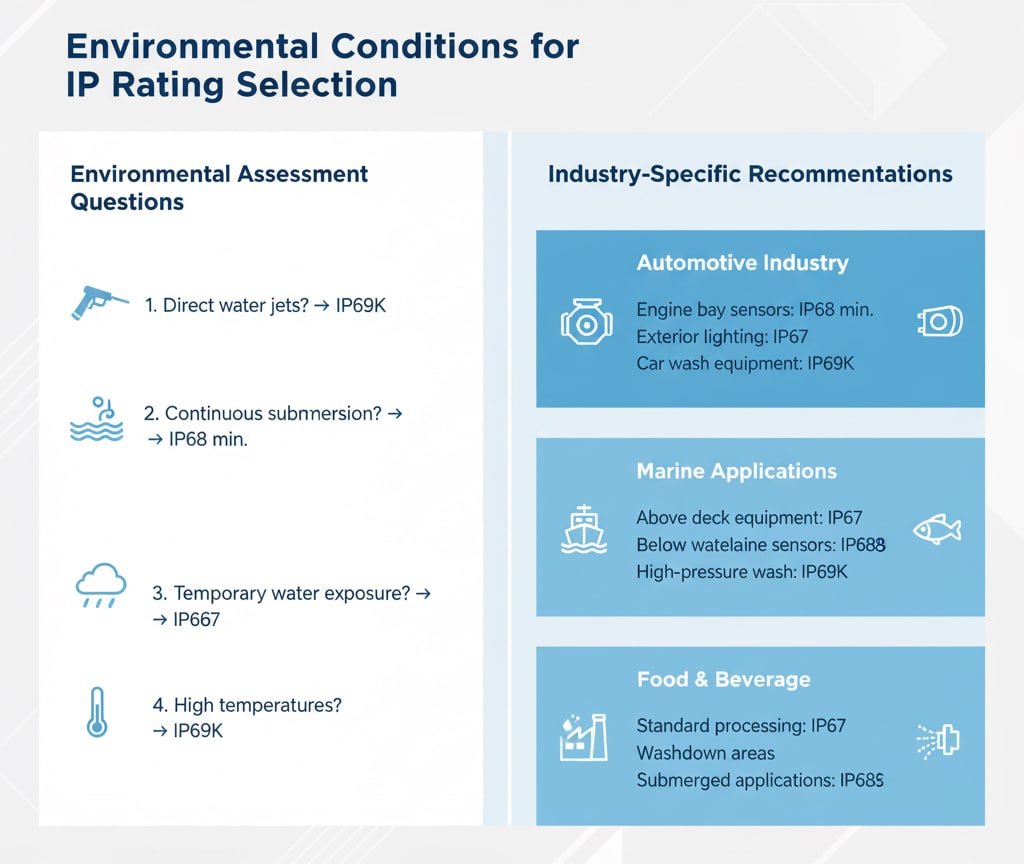
- Will the connector face direct water jets? → Consider IP69K
- Is continuous submersion possible? → Minimum IP68 required
- Is temporary water exposure the main concern? → IP67 may suffice
- Are high temperatures involved? → IP69K for heated wash applications
Industry-Specific Recommendations
Automotive Industry:
- Engine bay sensors: IP68 minimum
- Exterior lighting: IP67 adequate
- Car wash equipment: IP69K essential
Marine Applications:
- Above deck equipment: IP67
- Below waterline sensors: IP68
- High-pressure wash systems: IP69K
Food & Beverage:
- Standard processing: IP67
- Washdown areas: IP69K
- Submerged applications: IP68
Remember, higher IP ratings typically mean higher costs. I recently helped Hassan, a chemical plant manager in Saudi Arabia, save 30% on his project budget by using IP67 connectors for elevated installations instead of specifying IP68 across the board. The key is right-sizing protection to actual environmental demands.
What Are the Testing Standards Behind These Ratings?
Understanding the testing procedures helps you trust the ratings and spot potential issues with uncertified products.
IP rating tests follow strict IEC 60529 protocols using standardized equipment, specific test durations, and pass/fail criteria that leave no room for interpretation.
IP67 Testing Protocol
- Dust test: 8 hours in a dust chamber with talcum powder circulation
- Water test: 30-minute immersion at 1-meter depth in a standardized tank
- Temperature: Tests conducted at room temperature (typically 20°C)
IP68 Testing Protocol
- Dust test: Identical to IP67
- Water test: Continuous submersion at manufacturer-specified depth and duration
- Pressure consideration: Must account for hydrostatic pressure2 at test depth
IP69K Testing Protocol
- Dust test: Same as IP67/IP68
- High-pressure test: 80-100 bar water pressure at 80°C
- Multi-angle testing: Water jets applied from four different angles
- Duration: Typically 30 seconds per angle
At Bepto, our testing facility includes all necessary equipment for these protocols. We maintain IEC 17025 accreditation, ensuring our test results are internationally recognized.
How Do You Verify Authentic IP Rating Certifications?
Unfortunately, I’ve encountered numerous cases of falsified IP rating claims. Here’s how to protect yourself:
Red Flags to Watch For
- Certificates without accredited lab logos
- Vague test conditions (no specific depth/duration for IP68)
- Missing test report numbers
- Certificates that can’t be verified online
Verification Best Practices
- Request complete test reports, not just certificates
- Verify testing lab accreditation through official databases
- Check for specific test conditions (depth, duration, temperature)
- Ask for batch testing documentation for production units
Our Bepto connectors come with complete documentation packages including:
- Original test reports from TUV-certified labs
- Batch-specific quality certificates
- Traceability documentation
- Online verification codes
When David questioned our IP68 claims, I provided him with our complete TUV test report showing 72-hour submersion at 15 meters depth—far exceeding standard requirements. This transparency sealed the deal and built long-term trust.
Conclusion
Understanding IP ratings isn’t just about memorizing numbers—it’s about making informed decisions that protect your projects and investments. Whether you need IP67 for outdoor applications, IP68 for submersion environments, or IP69K for extreme washdown conditions, the key is matching protection levels to actual environmental demands. Remember, authentic certification from accredited labs is non-negotiable, and working with experienced suppliers like Bepto ensures you get both the right protection and the documentation to prove it. 😉
FAQs About IP Ratings
Q: Can IP67 connectors be used underwater permanently?
A: No, IP67 connectors are only rated for temporary immersion up to 1 meter for 30 minutes maximum. For permanent underwater installation, you need minimum IP68 rating with manufacturer-specified depth and duration limits.
Q: Is IP69K better than IP68 for all applications?
A: Not necessarily. IP69K excels against high-pressure jets but isn’t specifically rated for continuous submersion like IP68. Choose based on your specific environmental challenges—submersion requires IP68, while high-pressure washdown needs IP69K.
Q: How do I know if an IP rating certificate is legitimate?
A: Verify the testing laboratory’s accreditation through official databases, check for specific test conditions and report numbers, and ensure certificates include accredited lab logos. Legitimate suppliers provide complete test reports, not just summary certificates.
Q: What’s the difference between IP68 ratings from different manufacturers?
A: IP68 allows manufacturers to specify their own depth and duration limits beyond the 1-meter minimum. Always check the specific test conditions—one manufacturer’s IP68 might be 3 meters for 24 hours while another’s could be 10 meters for 72 hours.
Q: Do higher IP ratings always mean better quality connectors?
A: Higher IP ratings mean better environmental protection but may include design trade-offs like larger size, higher cost, or more complex installation. Choose the IP rating that matches your actual environmental requirements rather than automatically selecting the highest available.