Confused about IP ratings when selecting cable glands? You’re not alone – many engineers struggle with understanding what IP68, IP67, or IP65 actually means for their applications.
IP (Ingress Protection) ratings, defined by IEC 605291 standard, indicate how well electrical enclosures protect against solid particles and liquids. The two-digit system helps you choose cable glands that ensure optimal protection for your specific environment.
Last week, I had a fascinating conversation with David, a procurement manager from Germany. He was frustrated because his previous supplier’s “IP68” cable glands failed after just three months in his outdoor application. That’s when I realized many people don’t fully understand what these numbers really mean 😉
Table of Contents
- What Does Each Digit in IP Rating Actually Mean?
- Which IP Rating Do You Need for Your Application?
- How Do We Test IP Ratings According to IEC 60529?
- What Are the Most Common IP Rating Mistakes?
What Does Each Digit in IP Rating Actually Mean?
Ever wondered why IP ratings have two digits? Let me break this down for you.
The first digit (0-6) indicates protection against solid particles, while the second digit (0-9) shows liquid protection level. Higher numbers mean better protection, but you don’t always need the highest rating.
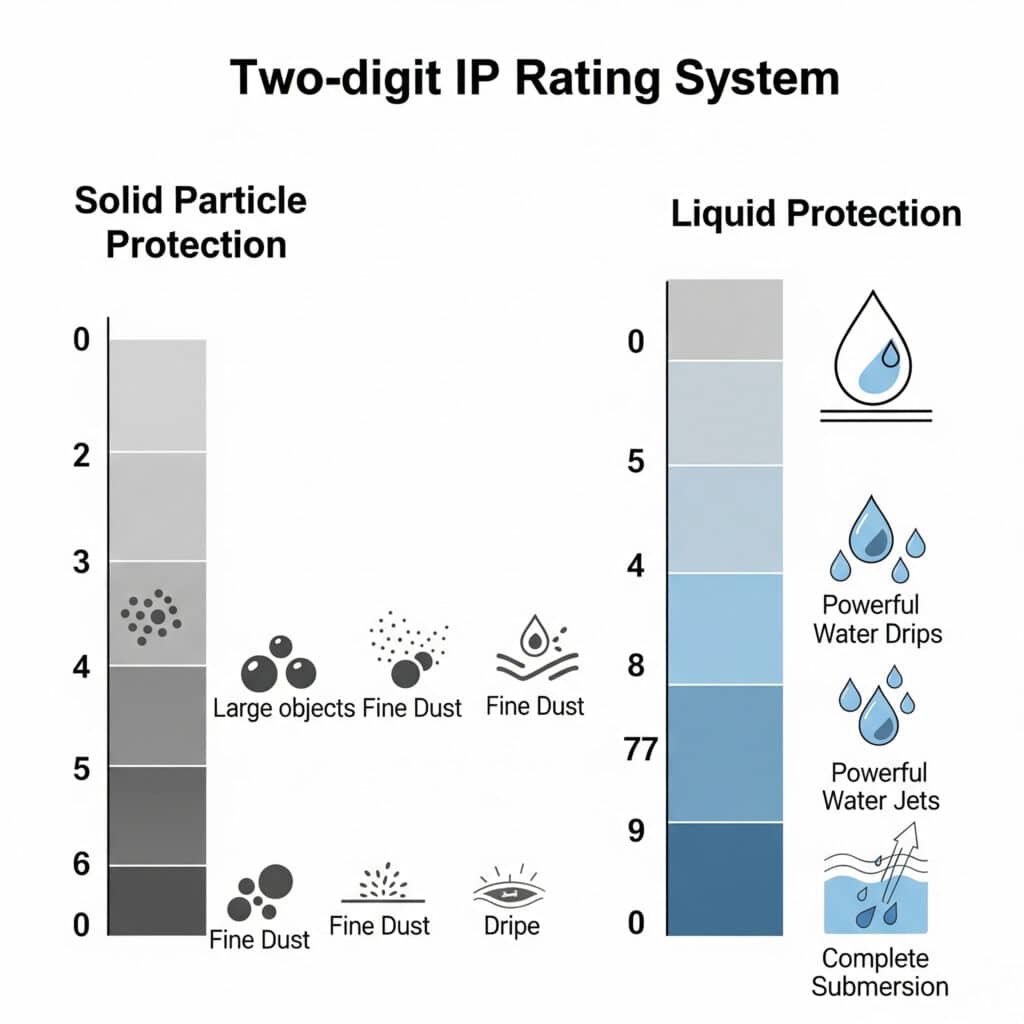
First Digit: Solid Particle Protection
| Rating | Protection Level | What It Means |
|---|---|---|
| 0 | No protection | Completely open |
| 1 | >50mm | Large body parts (hands) |
| 2 | >12.5mm | Fingers, similar objects |
| 3 | >2.5mm | Tools, thick wires |
| 4 | >1mm | Small wires, screws |
| 5 | Dust protected | Limited dust ingress |
| 6 | Dust tight | Complete dust protection |
Second Digit: Liquid Protection
| Rating | Protection Level | Test Conditions |
|---|---|---|
| 0 | No protection | None |
| 1 | Dripping water | Vertical drops |
| 2 | Dripping water (15°) | Tilted up to 15° |
| 3 | Spraying water | 60° from vertical |
| 4 | Splashing water | All directions |
| 5 | Water jets | 6.3mm nozzle |
| 6 | Powerful water jets | 12.5mm nozzle |
| 7 | Immersion up to 1m | 30 minutes |
| 8 | Immersion beyond 1m | Continuous |
| 9 | High pressure/temperature | Steam cleaning |
At Bepto, we manufacture cable glands ranging from IP54 to IP68. Our most popular models are IP68 rated because they offer excellent protection for most industrial applications.
Which IP Rating Do You Need for Your Application?
Choosing the wrong IP rating can be costly – too low and you risk equipment failure, too high and you’re overpaying.
For most industrial applications, IP65-IP68 cable glands provide adequate protection. Indoor applications typically need IP54-IP65, while outdoor or harsh environments require IP67-IP68 ratings.

Application-Based IP Rating Guide
Indoor Applications:
- Control panels: IP54-IP65
- Server rooms: IP20-IP54
- Clean manufacturing: IP65
Outdoor Applications:
- Street lighting: IP65-IP67
- Marine equipment: IP67-IP68
- Underground installations: IP68
Harsh Environments:
- Chemical plants: IP68 + chemical resistance
- Food processing: IP69K2 (high-pressure cleaning)
- Mining operations: IP68 + explosion-proof
Hassan, one of our clients from a petrochemical plant in Saudi Arabia, initially wanted IP65 cable glands to save costs. After I explained the risks of hydrogen sulfide3 exposure in his environment, he upgraded to our IP68 stainless steel cable glands with additional chemical resistance. Two years later, his maintenance team reports zero failures.
Cost vs. Protection Analysis
Here’s what I tell my clients: Don’t over-specify, but don’t under-protect either.
- IP54: Basic protection, lowest cost
- IP65: Standard industrial protection, good value
- IP67: Enhanced protection, moderate premium
- IP68: Maximum protection, highest investment
How Do We Test IP Ratings According to IEC 60529?
Understanding how IP ratings are tested helps you trust the certification process.
IEC 60529 defines specific test procedures for each IP rating level. Tests must be performed by accredited laboratories using standardized equipment, duration, and conditions to ensure consistent results worldwide.
Our Testing Process at Bepto
Solid Particle Testing (First Digit):
- IP5X: 8-hour dust chamber test with talcum powder
- IP6X: 8-hour test with fine dust, vacuum applied
- Temperature: 40°C ± 2°C
- Air circulation: Continuous
Liquid Protection Testing (Second Digit):
- IPX7: 30-minute immersion at 1-meter depth
- IPX8: Continuous immersion (we test at 2-meter depth for 24 hours)
- Water temperature: 15-35°C
- Post-test inspection: No water ingress allowed
Third-Party Certifications We Hold
At Bepto, all our IP-rated cable glands are tested and certified by:
- TUV Rheinland4 (Germany)
- SGS (Switzerland)
- DEKRA (Netherlands)
We don’t just meet IEC 60529 standards – we exceed them. Our IP68 cable glands are tested at 3-meter depth for 72 hours, far beyond the standard requirements.
What Are the Most Common IP Rating Mistakes?
I’ve seen too many projects fail because of IP rating misunderstandings. Let me share the biggest mistakes I encounter.
The most common mistakes include assuming higher IP ratings are always better, ignoring temperature effects on sealing, and not considering long-term degradation of gaskets and seals.

Top 5 IP Rating Mistakes
1. Confusing IP67 and IP68 Capabilities
- IP67: Temporary immersion (30 minutes max)
- IP68: Continuous immersion (manufacturer-specified depth)
- Many assume they’re interchangeable – they’re not!
2. Ignoring Temperature Effects
Standard IP tests are performed at room temperature. High temperatures can cause:
- Gasket expansion and failure
- Seal degradation
- Reduced protection levels
3. Installation Errors
Even IP68 cable glands fail if:
- Gaskets are damaged during installation
- Cable diameter doesn’t match gland specifications
- Proper torque isn’t applied
4. Mixing IP Ratings in Same Enclosure
Using IP54 cable glands in an IP67 enclosure creates the weakest link problem.
5. Not Planning for Maintenance
IP ratings can degrade over time due to:
- UV exposure (outdoor applications)
- Chemical exposure
- Mechanical stress
- Temperature cycling
Real-World Example: Learning from Failure
David’s original supplier claimed IP68 rating but used standard NBR gaskets instead of FKM (Viton)5 for his chemical processing application. The gaskets degraded within months, causing water ingress and equipment failure.
At Bepto, we always ask about your specific environment before recommending gasket materials. For chemical applications, we use FKM gaskets that maintain IP68 protection even after 5+ years of exposure.
Conclusion
Understanding IP ratings according to IEC 60529 helps you select cable glands that truly protect your equipment while optimizing costs.
FAQs About IP Protection Ratings
Q: Is IP68 always better than IP67?
A: Not necessarily. IP68 means continuous immersion at manufacturer-specified depth, while IP67 handles temporary immersion up to 1 meter. Choose based on your actual application needs, not just higher numbers.
Q: How long do IP ratings last in real applications?
A: IP ratings can last 10+ years with proper installation and suitable gasket materials. However, harsh environments (UV, chemicals, extreme temperatures) may require more frequent inspection and gasket replacement.
Q: Can I upgrade an IP54 cable gland to IP68 by changing gaskets?
A: No. IP ratings depend on the entire gland design, including housing tolerances, thread design, and sealing mechanisms. You need a purpose-built IP68 cable gland for reliable protection.
Q: What’s the difference between IP69K and IP68?
A: IP69K includes high-pressure, high-temperature water jet testing (80°C, 8-10 MPa pressure) specifically for food processing and automotive industries. IP68 focuses on immersion protection.
Q: Do IP ratings apply to both cable entry and the gland body?
A: Yes. A properly rated cable gland must seal both around the cable and where the gland connects to the enclosure. Both sealing points must meet the specified IP rating.
-
Explore the official IEC 60529 standard that defines the Ingress Protection (IP) rating system. ↩
-
Learn about the IP69K rating and its specific testing requirements for high-pressure, high-temperature washdown protection. ↩
-
Understand the properties of hydrogen sulfide ($H_2S$) and its highly corrosive effects on metals and other materials. ↩
-
Visit the website of TÜV Rheinland, a global leader in independent testing, inspection, and certification services. ↩
-
Compare the chemical resistance and temperature performance of common elastomer materials like NBR and FKM (Viton®). ↩