Just yesterday, I received a call from Jennifer, an electrical engineer at a wind farm in Texas. She was struggling to find the right cable glands for her 22mm armored power cables and kept getting conflicting advice from different suppliers. “Samuel,” she said, “everyone keeps suggesting different sizes – some say 25mm, others say 32mm. What’s the real answer?”
28mm cable glands are specifically designed to accommodate cables with outer diameters ranging from 18-25mm, making them ideal for medium-duty power cables, instrumentation bundles, and armored control cables in industrial applications.
This confusion about 28mm cable glands is more common than you might think. After a decade of helping engineers and procurement managers navigate cable gland specifications, I’ve learned that 28mm represents a critical size gap that many suppliers overlook. Let me share everything you need to know about this often-misunderstood cable gland size.
Table of Contents
- What Are 28mm Cable Glands and Their Key Specifications?
- What Applications Require 28mm Cable Glands?
- How Do You Size 28mm Cable Glands Correctly?
- What Materials and Standards Apply to 28mm Cable Glands?
- How Do 28mm Cable Glands Compare to Other Sizes?
- FAQ
What Are 28mm Cable Glands and Their Key Specifications?
Understanding 28mm cable glands starts with recognizing they fill a specific niche in the cable management ecosystem. Unlike more common sizes like 20mm or 32mm, 28mm glands address the gap for medium-diameter cables that are too large for standard sizes but don’t require the next size up.
28mm cable glands typically accommodate cable outer diameters from 18-25mm and commonly feature M32 threading for panel mounting, though some manufacturers offer M28 threading for specialized applications.

Technical Specifications Overview
At Bepto Connector, we manufacture 28mm cable glands with these standard specifications:
| Specification | Standard Range | Notes |
|---|---|---|
| Cable Diameter | 18-25mm | Outer diameter including sheath |
| Thread Size | M32 x 1.5 (most common) | Some M28 x 1.5 available |
| IP Rating | IP68 standard | Up to IP69K for special applications |
| Temperature Range | -40°C to +100°C | Standard EPDM seals |
| Material Options | Brass, SS316L, Aluminum | Nylon available for non-metallic |
Why 28mm Exists as a Size
The 28mm designation isn’t arbitrary – it addresses real-world cable sizing gaps. Many industrial cables fall into the 20-24mm outer diameter range, making them too large for 25mm glands but unnecessarily oversized for 32mm glands. This creates both cost and space efficiency issues.
I remember working with Hassan, a project manager at a petrochemical facility in Kuwait, who was dealing with exactly this issue. His 22mm armored cables needed proper strain relief and sealing, but 25mm glands were too tight and 32mm glands wasted valuable panel space. Our 28mm solution provided the perfect fit while maintaining his required ATEX certification1.
Construction and Design Features
28mm cable glands incorporate several design elements that distinguish them from other sizes:
- Enhanced sealing geometry: Optimized for the specific cable diameter range
- Improved strain relief: Designed for the mechanical properties of medium-diameter cables
- Compact threading: M32 threading provides secure mounting without excessive bulk
- Material optimization: Wall thickness optimized for strength without unnecessary weight
What Applications Require 28mm Cable Glands?
The 28mm cable gland finds its niche in specific industrial applications where cable diameter and installation constraints demand this precise sizing. Understanding these applications helps engineers make informed specification decisions.
Primary applications include renewable energy installations, process control systems, marine electronics, and industrial automation where 20-24mm cables are standard but space efficiency and proper sealing are critical.
Renewable Energy Applications
Wind Power Systems
Wind turbines commonly use 20-22mm power and control cables that require weatherproof sealing and vibration resistance. The 28mm gland provides optimal grip and sealing for these applications.
Solar Installations
Large solar arrays often employ 22-24mm DC power cables that need UV-resistant, weatherproof connections. Our 28mm glands with specialized UV-resistant seals excel in these environments.

Industrial Process Control
Instrumentation Systems
Process industries often bundle multiple instrumentation cables into 20-23mm composite cables. The 28mm gland accommodates these bundles while maintaining individual circuit integrity.
Motor Control Centers
Variable frequency drives2 and motor control applications frequently use 21-24mm power cables that require EMC shielding3 and proper grounding – perfect applications for our EMC-rated 28mm metal glands.
Marine and Offshore Applications
The marine industry presents unique challenges for cable glands, and 28mm sizes address specific needs:
- Navigation equipment: 22mm coaxial and power cable bundles
- Engine room applications: Oil-resistant sealing for 20-24mm control cables
- Deck equipment: Salt spray resistant connections for winch and crane controls
I recently worked with a shipyard in Singapore where they needed cable glands for their new offshore supply vessel. The navigation system used 23mm composite cables that required IP68 sealing and salt spray resistance. Our 28mm marine-grade glands with 316L stainless steel construction and Viton seals provided the perfect solution.
Specialized Industrial Applications
Food Processing Equipment
Washdown environments require cable glands that can handle high-pressure cleaning while sealing 20-24mm food-grade cables. Our 28mm glands with FDA-approved seals meet these demanding requirements.
Pharmaceutical Manufacturing
Clean room environments often use specialized 22mm cables for process control that require both sealing and easy decontamination. The smooth surfaces of our 28mm stainless steel glands facilitate proper cleaning protocols.
How Do You Size 28mm Cable Glands Correctly?
Proper sizing of 28mm cable glands requires understanding both cable characteristics and installation requirements. Incorrect sizing leads to compromised sealing, inadequate strain relief, and potential safety hazards.
Correct sizing involves measuring actual cable outer diameter, considering environmental expansion, verifying thread compatibility, and ensuring adequate strain relief for the specific cable construction and application loads.
Step-by-Step Sizing Process
Step 1: Accurate Cable Measurement
Use precision calipers to measure cable outer diameter at the thickest point, including any armor, sheathing, or protective covering. Take measurements at multiple points to account for cable variations.
Step 2: Environmental Considerations
Add tolerance for thermal expansion:
- Standard environments: Add 5-10% to measured diameter
- High temperature: Add 15-20% for cables operating above 60°C
- Outdoor applications: Consider UV degradation effects on cable sheath
Step 3: Application Load Analysis
Consider mechanical stresses:
- Static installations: Standard grip length adequate
- Moving applications: Extended grip length required
- High vibration: Enhanced strain relief necessary
Cable Compatibility Matrix
| Cable Type | Typical OD Range | 28mm Gland Suitability | Special Considerations |
|---|---|---|---|
| Armored Power | 20-24mm | Excellent | Requires earth tag |
| Control Multi-core | 18-23mm | Excellent | EMC versions available |
| Instrumentation | 19-22mm | Good | Consider individual sealing |
| Coaxial Bundles | 21-25mm | Good | EMC shielding critical |
| Fiber Optic | 18-20mm | Adequate | Bend radius protection needed |
Threading and Mounting Considerations
Most 28mm cable glands use M32 x 1.5 threading, but verification is essential:
Equipment Compatibility Check:
- Measure threaded hole diameter with calipers
- Verify thread pitch with thread gauge
- Check panel thickness for adequate thread engagement
- Consider lock nut requirements for thin panels
Alternative Threading Options:
- M28 x 1.5: Less common, used in space-constrained applications
- NPT equivalent: 1-1/4″ NPT for American equipment compatibility
- Custom threading: Available for specialized applications
What Materials and Standards Apply to 28mm Cable Glands?
Material selection for 28mm cable glands depends on environmental conditions, safety requirements, and performance specifications. Understanding these factors ensures optimal long-term performance and compliance with applicable standards.
Common materials include brass for general industrial use, 316L stainless steel for corrosive environments, and aluminum for weight-sensitive applications. Each material requires specific sealing compounds and meets different certification standards.
Material Selection Guide
Brass Cable Glands
Our standard brass 28mm glands use CW617N brass (dezincification resistant) with these characteristics:
- Temperature range: -20°C to +80°C standard operation
- Corrosion resistance: Good in most industrial environments
- Cost effectiveness: Optimal balance of performance and price
- Certifications: CE, RoHS, IP68 standard
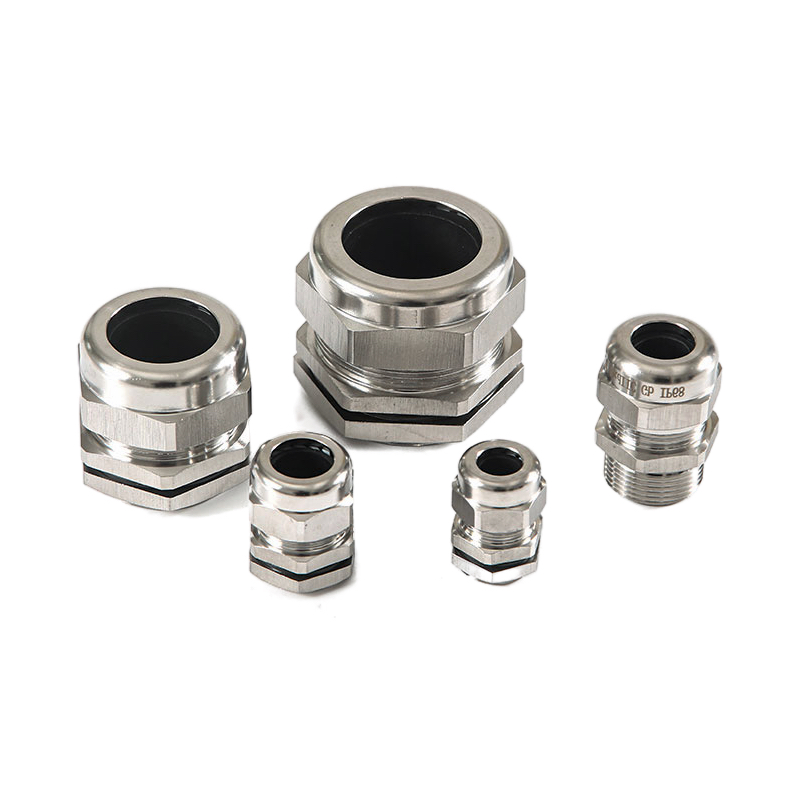
Stainless Steel Options
316L stainless steel provides superior corrosion resistance:
- Marine applications: Excellent salt spray resistance
- Chemical processing: Resistant to most industrial chemicals
- Food grade: FDA-approved materials available
- Temperature range: -40°C to +150°C depending on seal material
Sealing Material Compatibility
| Seal Material | Temperature Range | Chemical Compatibility | Typical Applications |
|---|---|---|---|
| EPDM | -40°C to +120°C | General industrial chemicals | Standard industrial |
| NBR | -30°C to +100°C | Oil and fuel resistant | Automotive, machinery |
| Viton (FKM) | -20°C to +200°C | Excellent chemical resistance | Chemical processing |
| Silicone | -60°C to +180°C | Food grade available | Food processing |
Certification and Standards Compliance
International Standards:
- IEC 624444: Cable glands for electrical installations
- EN 50262: Metric cable glands for electrical installations
- UL 514B: Fittings for use in hazardous locations
- ATEX/IECEx: Explosive atmosphere certifications
Quality Certifications:
At Bepto, our 28mm cable glands carry:
- ISO 9001: Quality management systems
- IATF 16949: Automotive quality standards
- CE marking: European conformity
- RoHS compliance5: Restriction of hazardous substances
I worked with a pharmaceutical company in Switzerland that required 28mm cable glands meeting both FDA food contact standards and ATEX Zone 1 certification for their solvent processing equipment. This required special 316L construction with Viton seals and additional explosion-proof certifications – a perfect example of how material selection impacts compliance requirements.
How Do 28mm Cable Glands Compare to Other Sizes?
Understanding how 28mm cable glands relate to other common sizes helps engineers make informed decisions and avoid over-specification or under-specification issues that can impact both performance and cost.
28mm cable glands bridge the gap between 25mm and 32mm sizes, offering optimal fit for 20-24mm cables while providing better space efficiency than larger alternatives and superior sealing compared to smaller sizes.
Size Comparison Matrix
| Gland Size | Cable Range | Common Threading | Typical Applications | Cost Relative to 28mm |
|---|---|---|---|---|
| 20mm | 10-14mm | M20 x 1.5 | Light control cables | -15% |
| 25mm | 13-18mm | M25 x 1.5 | Standard power cables | -10% |
| 28mm | 18-25mm | M32 x 1.5 | Medium power/control | Baseline |
| 32mm | 22-29mm | M32 x 1.5 | Heavy power cables | +20% |
| 40mm | 30-38mm | M40 x 1.5 | Large power cables | +45% |
Performance Advantages of 28mm Sizing
Optimal Cable Grip
The 28mm size provides superior strain relief for cables in the 20-24mm range compared to oversized alternatives:
- Better compression ratio: Optimal seal compression without over-stressing cable sheath
- Improved strain relief: Proper grip length for cable construction
- Enhanced sealing: Consistent seal contact pressure across cable circumference
Space Efficiency
Compared to 32mm glands, 28mm options provide:
- Reduced panel space: 20% smaller mounting footprint
- Lower profile: Important in space-constrained installations
- Weight savings: Significant in applications where weight matters
When to Choose 28mm Over Alternatives
Choose 28mm Instead of 25mm When:
- Cable diameter exceeds 18mm consistently
- Enhanced strain relief required for heavy cables
- Future cable upgrades anticipated within size range
- Environmental conditions require robust sealing
Choose 28mm Instead of 32mm When:
- Panel space is limited
- Cost optimization is important
- Cable diameter is consistently under 24mm
- Weight reduction is beneficial
Real-World Application Examples
Let me share a recent project that perfectly illustrates 28mm advantages. We worked with an automation company in Germany installing control systems for a automotive manufacturing line. They had:
- Cable requirement: 21mm multi-core control cables
- Space constraints: Dense panel layout with limited real estate
- Environmental needs: IP67 protection with washdown capability
- Cost pressure: Budget optimization without compromising quality
The 25mm glands were too tight for reliable long-term sealing, while 32mm glands consumed excessive panel space and increased costs. Our 28mm solution provided the perfect balance – optimal sealing, efficient space utilization, and cost-effective performance.
Installation and Maintenance Considerations
Installation Advantages:
- Standard tooling: Uses common wrench sizes (typically 41mm hex)
- Familiar procedures: Installation similar to other metric glands
- Component availability: Seals and parts readily available
Maintenance Benefits:
- Service accessibility: Compact size allows easier access in crowded panels
- Component costs: Replacement parts cost-effective compared to larger sizes
- Inventory efficiency: Single size covers wide cable range
Conclusion
28mm cable glands serve a critical role in modern electrical installations, providing optimal solutions for medium-diameter cables where standard sizes fall short. Understanding their specifications, applications, and sizing requirements ensures successful installations that deliver long-term reliability and cost effectiveness.
Whether you’re working on renewable energy projects, industrial automation, or marine applications, the 28mm cable gland offers the perfect balance of performance, space efficiency, and cost optimization. At Bepto Connector, we’re committed to providing high-quality 28mm solutions that meet the demanding requirements of today’s electrical installations.
FAQ
Q: What cable diameter range do 28mm cable glands accommodate?
A: 28mm cable glands typically accommodate cables with outer diameters from 18-25mm. This makes them ideal for medium-duty power cables, instrumentation bundles, and armored control cables that are too large for 25mm glands but don’t require 32mm sizing.
Q: What thread size do most 28mm cable glands use?
A: Most 28mm cable glands use M32 x 1.5 threading for panel mounting, though some manufacturers offer M28 x 1.5 threading for specialized space-constrained applications. Always verify your equipment’s threaded hole specifications before ordering.
Q: Are 28mm cable glands available in explosion-proof ratings?
A: Yes, 28mm cable glands are available with ATEX and IECEx certifications for explosive atmosphere applications. These typically feature brass or stainless steel construction with specialized sealing systems and proper grounding provisions for hazardous location use.
Q: How do I choose between 28mm and 32mm cable glands for a 22mm cable?
A: For a 22mm cable, 28mm glands provide better sealing compression and strain relief, while using less panel space and costing less. Choose 32mm only if you need accommodation for future cable upgrades or have specific environmental requirements that demand the larger size.
Q: What materials are available for 28mm cable glands?
A: Common materials include brass (CW617N) for general industrial use, 316L stainless steel for corrosive environments, and aluminum for weight-sensitive applications. Nylon versions are also available for non-metallic applications. Material selection depends on environmental conditions and certification requirements.
-
Learn about the EU directive regulating equipment intended for use in explosive atmospheres. ↩
-
Understand the mechanism of Variable Frequency Drives in controlling electric motor speed and torque. ↩
-
Explore the principles of Electromagnetic Compatibility shielding for preventing signal interference. ↩
-
View the specific international standard requirements for cable gland retention and sealing. ↩
-
Read the official details regarding the Restriction of Hazardous Substances in electrical equipment. ↩