Last week, Marcus, an electrical engineer from a steel mill in Pittsburgh, faced a nightmare scenario. His newly installed junction boxes started overheating, causing production shutdowns and safety concerns. The culprit? Wrong terminal block selection that couldn’t handle the 200-amp load currents in his motor control circuits.
The key to selecting terminal blocks for industrial junction boxes is matching the electrical ratings, environmental conditions, and connection requirements to your specific application. You must consider current capacity, voltage rating, wire gauge compatibility, mounting method, and safety features before making your choice.
This isn’t just about making electrical connections – it’s about ensuring safety, reliability, and long-term performance. In my decade of experience at Bepto Connector, I’ve seen how the right terminal block selection can make or break an entire electrical installation. Let me guide you through the essential factors that will help you make the perfect choice.
Table of Contents
- What Are the Different Types of Terminal Blocks?
- How Do You Determine Electrical Requirements?
- Which Environmental Factors Affect Terminal Block Selection?
- What Installation and Maintenance Considerations Matter?
- FAQs About Terminal Block Selection
What Are the Different Types of Terminal Blocks?
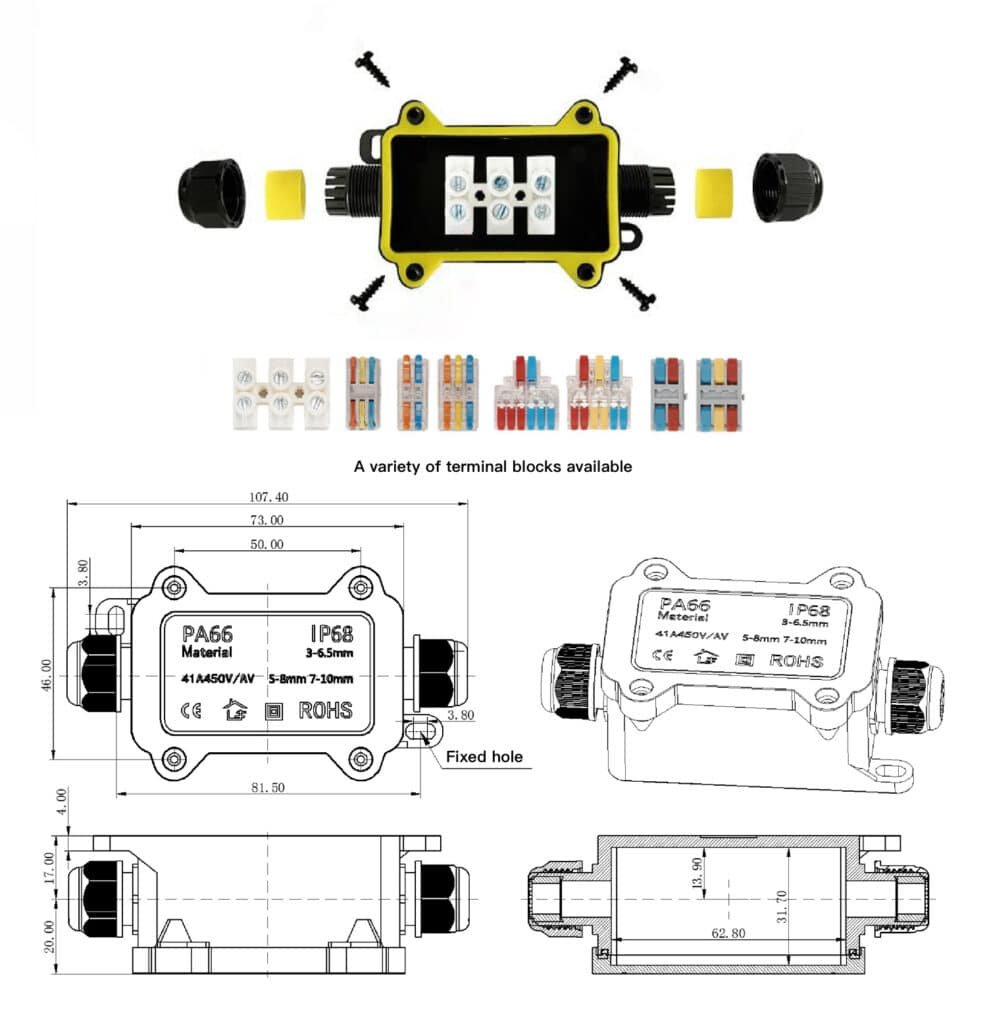
Understanding terminal block types is crucial because each serves specific applications and offers unique advantages. The wrong type can lead to installation difficulties, maintenance issues, and potential safety hazards.

Screw Terminal Blocks
The most common and versatile option for industrial applications:
Standard Screw Terminals: Reliable, time-tested design perfect for permanent installations. These work excellently for control circuits and low-to-medium current applications.
Captive Screw Terminals: Prevent screw loss during maintenance – a lifesaver when working in tight spaces or elevated locations.
Advantages:
- Proven reliability and durability
- Wide range of current ratings (2A to 300A+)
- Compatible with various wire types and sizes
- Easy visual inspection of connections
Best Applications: Motor control circuits, power distribution, permanent installations where vibration is minimal.
Spring-Cage Terminal Blocks
Modern, maintenance-friendly alternative gaining popularity:
Push-In Technology: Simply insert stripped wire – no tools required for solid conductors up to 2.5mm².
Lever-Actuated: Lift the lever, insert wire, release lever. Perfect for stranded conductors and field modifications.
Ahmed, who manages a water treatment facility in Abu Dhabi, switched to our spring-cage terminals after experiencing frequent loose connections with traditional screw terminals due to thermal cycling1. He’s had zero connection failures in two years since the upgrade.
Advantages:
- Faster installation (up to 50% time savings)
- Consistent connection force
- Excellent vibration resistance
- Tool-free wire removal for maintenance
Barrier Terminal Blocks
Cost-effective solution for basic applications:
Fixed Barrier Design: Individual compartments prevent accidental contact between adjacent circuits.
Sectional Design: Modular construction allows custom configurations.
Typical Applications:
- Low-voltage control circuits
- Signal and communication wiring
- Budget-conscious installations
- Simple point-to-point connections
Specialty Terminal Blocks
Ground Terminal Blocks: Essential for safety grounding systems, featuring green/yellow identification and enhanced earth connection capabilities.
Fuse Terminal Blocks: Integrated fuse holders provide circuit protection at the terminal level – perfect for individual circuit protection.
Disconnect Terminal Blocks: Built-in switches allow circuit isolation without wire removal, ideal for testing and maintenance.
How Do You Determine Electrical Requirements?
Proper electrical specification prevents overheating, voltage drop, and potential fire hazards. Never underestimate electrical requirements – safety depends on getting this right.
Current Rating Calculations
Continuous Current: Your terminal block must handle 125% of the maximum expected continuous current. For a 20A motor circuit, specify terminals rated for at least 25A.
Short-Circuit Current: Consider fault current capabilities. Industrial environments can experience short-circuit currents of 10,000A or more.
- Temperature: Reduce rating by 20% for ambient temperatures above 40°C
- Altitude: Reduce by 10% for installations above 2000m elevation
- Grouping: Multiple adjacent current-carrying terminals generate heat
Voltage Ratings and Clearances
Working Voltage: Always specify terminals rated 20% above system voltage. For 480V systems, use 600V-rated terminals minimum.
Impulse Voltage: Consider transient overvoltages from switching operations, lightning, or motor starting.
Creepage and Clearance Distances3:
- Pollution Degree 2 (normal industrial): 6.3mm clearance for 300V systems
- Pollution Degree 3 (heavy industrial): 10mm clearance for 300V systems
Wire Gauge Compatibility
Match terminal block specifications to your wire requirements:
| Wire Size (AWG) | Typical Current | Terminal Type | Torque Spec |
|---|---|---|---|
| 24-18 | 1-10A | Standard screw | 0.5-0.6 Nm |
| 16-14 | 10-20A | Standard screw | 0.8-1.0 Nm |
| 12-10 | 20-35A | Heavy-duty screw | 1.2-1.5 Nm |
| 8-6 | 35-65A | Power terminal | 2.0-2.5 Nm |
Connection Methods
Single Wire: Most common, one wire per terminal point.
Multiple Wire: Some terminals accept multiple wires – verify current derating factors.
Ferrules4: Highly recommended for stranded wire connections, prevent strand breakage and ensure reliable contact.
Which Environmental Factors Affect Terminal Block Selection?
Environmental conditions directly impact terminal block performance and longevity. Ignoring these factors leads to premature failure and safety hazards.
Temperature Considerations
Operating Temperature Range:
- Standard: -5°C to +60°C for most industrial applications
- Extended: -25°C to +80°C for harsh environments
- High-Temperature: Up to +120°C for furnace and heat treatment applications
Thermal Cycling Effects: Repeated heating and cooling causes expansion/contraction, potentially loosening screw connections. Spring-cage terminals excel in these conditions.
Chemical Resistance
Housing Materials:
- Polyamide (PA): Good general chemical resistance, suitable for most industrial environments
- Polycarbonate (PC): Excellent impact resistance, transparent options available for visual inspection
- PBT (Polybutylene Terephthalate): Superior chemical resistance for aggressive environments
Metal Components:
- Brass: Standard for most applications, good conductivity and corrosion resistance
- Stainless Steel: Required for marine, food processing, and chemical applications
- Tin-Plated Copper: Enhanced corrosion protection for humid environments
Vibration and Shock Resistance
Industrial environments subject terminal blocks to mechanical stress:
Vibration Classes (per IEC 60068-2-6):
- Class 1: Light industrial (0.15mm amplitude)
- Class 2: Heavy industrial (0.35mm amplitude)
- Class 3: Mobile/transportation (0.75mm amplitude)
Shock Resistance: Specify terminals tested to IEC 60068-2-27 for applications with impact loads or seismic activity.
Moisture and Contamination
IP Ratings for Terminal Compartments:
- IP20: Finger-safe, basic protection
- IP30: Protection against 2.5mm objects
- IP54: Dust-protected, splash-resistant (when covers are closed)
Pollution Degrees:
- Degree 1: Clean environments (control rooms)
- Degree 2: Normal industrial (manufacturing floors)
- Degree 3: Heavy contamination (chemical plants, outdoor installations)
What Installation and Maintenance Considerations Matter?
Proper installation planning and maintenance access ensure long-term reliability and safety. Consider these factors during the design phase to avoid costly modifications later.
Mounting Systems
DIN Rail Mounting5: Industry standard, allows easy reconfiguration and expansion. Use 35mm rail for most applications, 15mm rail for compact installations.
Direct Mounting: Screw-mounted terminals for permanent installations or when DIN rail isn’t suitable.
Panel Mounting: Through-panel terminals for connections between different compartments.
Spacing and Layout
Minimum Spacing Requirements:
- 6mm between terminals for maintenance access
- 12mm for terminals with test points
- 20mm for high-current terminals requiring larger tools
Wire Management: Plan for proper wire routing and strain relief. Poor wire management causes connection stress and potential failures.
Identification and Marking
Terminal Marking: Essential for troubleshooting and maintenance. Options include:
- Laser engraving (permanent, professional appearance)
- Adhesive labels (flexible, field-changeable)
- Clip-on markers (removable, reusable)
Color Coding: Use consistent color schemes:
- Green/Yellow: Ground connections
- Blue: Neutral conductors
- Red/Brown/Black: Phase conductors
Testing and Commissioning
Connection Verification:
- Torque verification using calibrated tools
- Pull testing for spring-cage connections
- Thermal imaging during initial operation
Documentation Requirements:
- Terminal assignment schedules
- Torque specifications and verification records
- Maintenance procedures and schedules
Marcus from Pittsburgh learned this lesson the hard way. After our consultation, he upgraded to heavy-duty screw terminals rated for 250A with proper thermal management. His steel mill has been running smoothly for eight months now, with no overheating issues. 😉
Conclusion
Selecting the right terminal blocks for industrial junction boxes requires careful analysis of electrical requirements, environmental conditions, and installation constraints. Don’t compromise on quality or proper specification – the cost of failure far exceeds the investment in proper components. At Bepto Connector, we’ve helped thousands of customers avoid costly mistakes by providing expert guidance and high-quality terminal solutions. Remember, the best terminal block is the one that matches your specific application requirements perfectly.
FAQs About Terminal Block Selection
Q: What’s the difference between screw terminals and spring-cage terminals?
A: Screw terminals use mechanical clamping force from screws, while spring-cage terminals use spring pressure for consistent connection force. Spring-cage terminals offer faster installation and better vibration resistance, but screw terminals handle higher currents and are more cost-effective.
Q: How do I calculate the right current rating for my terminal blocks?
A: Use 125% of your maximum continuous current as the minimum rating. For a 20A circuit, specify at least 25A terminals. Apply derating factors for high temperature, altitude, and multiple adjacent current-carrying terminals.
Q: Can I mix different terminal block types in the same junction box?
A: Yes, but maintain consistent mounting systems (DIN rail) and ensure proper spacing. Different types may have different maintenance requirements, so document accordingly for technicians.
Q: What wire preparation is required for different terminal types?
A: Screw terminals require stripped wire ends, preferably with ferrules for stranded wire. Spring-cage terminals need clean, straight cuts with specific strip lengths (usually 10-12mm). Always follow manufacturer specifications.
Q: How often should terminal block connections be inspected?
A: Inspect screw terminals annually and re-torque if necessary. Spring-cage terminals typically require less frequent inspection but should be checked during scheduled maintenance. High-current applications may need more frequent inspection based on thermal cycling.
-
Learn how repeated temperature changes can affect the reliability and lifespan of electrical connections. ↩
-
Understand the principles of derating and how to adjust component ratings for environmental factors like temperature and altitude. ↩
-
Explore the definitions of creepage and clearance and why these distances are critical for electrical safety and insulation. ↩
-
See a guide on why and how to properly install ferrules to ensure secure and reliable stranded wire terminations. ↩
-
Discover the benefits and standard sizes of the DIN rail system used for mounting industrial control equipment. ↩